Farm Management Software Benefits: Increase Profit & Reduce Risk in Farming
Farm Management Software Benefits: Increase Profit & Reduce Risk in Farming
Introduction
In today’s farming environment, rising input costs, unpredictable weather, and strict quality standards are creating new challenges for farmers. Relying only on traditional experience is no longer enough to stay competitive.
Farm management software provides a centralized platform where farmers can manage all critical information—fields, crops, inputs, labor, and finances—in one place. This enables better planning, monitoring, and analysis of farm activities.
One of the biggest advantages is the quick return on investment, often within just one or two seasons.
Why Investing in Farm Management Software Pays
Farm management software helps improve crop yields by ensuring that every activity—from sowing to harvesting—is done at the right time and in the right way.
By tracking inputs and field operations, it highlights inefficiencies such as:
- Overuse of fertilizers
- Excessive pesticide applications
- Poor irrigation timing
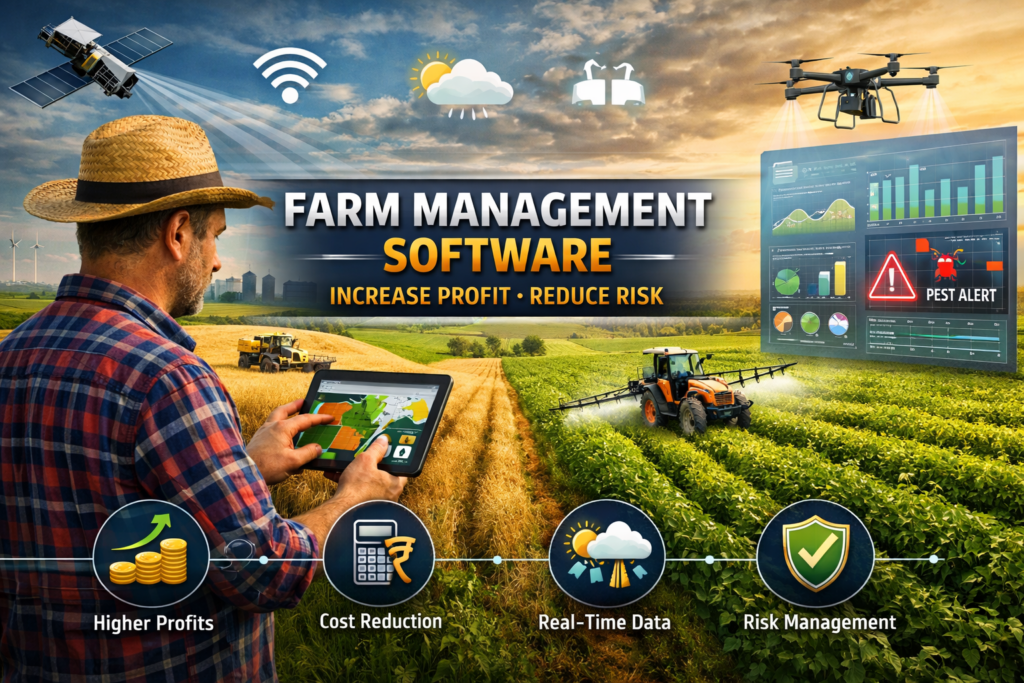
With the help of integrated weather data, satellite insights, and advisory systems, farmers can reduce risks, protect crop quality, and avoid unnecessary costs.
Compared to machinery or infrastructure investments that take years to recover, farm software requires lower initial investment and delivers faster financial returns.
Key ROI Drivers
The primary driver of return on investment is improved decision-making based on accurate data.
Farmers can use real-time and historical information to:
- Schedule irrigation more efficiently
- Apply crop protection at optimal times
- Plan harvests for better outcomes
Another major benefit is compliance and quality management. The software records pesticide usage, application timing, and dosage, helping farmers meet food safety standards and avoid rejected produce.
This not only protects income but also strengthens trust with buyers and processors.
Precision Tools and Input Optimization
Modern farm management platforms support precision agriculture practices such as variable-rate application.
By using data like soil health, satellite imagery, yield history, and field observations, farmers can:
- Apply inputs only where needed
- Reduce waste
- Improve productivity
It also helps identify underperforming areas within fields, allowing targeted improvements instead of uniform treatment. Over time, this leads to better resource use, healthier soil, and balanced crop growth.
Risk Reduction and Long-Term Benefits
Farm management software reduces risks by providing early alerts about:
- Pest and disease outbreaks
- Extreme weather conditions
- Crop stress
This allows farmers to take preventive action instead of reacting after damage occurs.
In the long term, the system builds a detailed digital record of farm activities. Farmers can compare seasons, evaluate results, and continuously improve their strategies.
This shifts farming from guesswork to a more predictable and data-driven approach.
Conclusion
Farm management software is becoming essential for modern agriculture. It helps farmers reduce costs, increase yields, and manage risks more effectively.
With its fast return on investment and long-term benefits, adopting digital tools is a smart decision for farmers who want to stay competitive and profitable in today’s changing agricultural landscape.