EU Greenwashing Rules 2026: Indian Farmers & Exporters Must Prepare Now
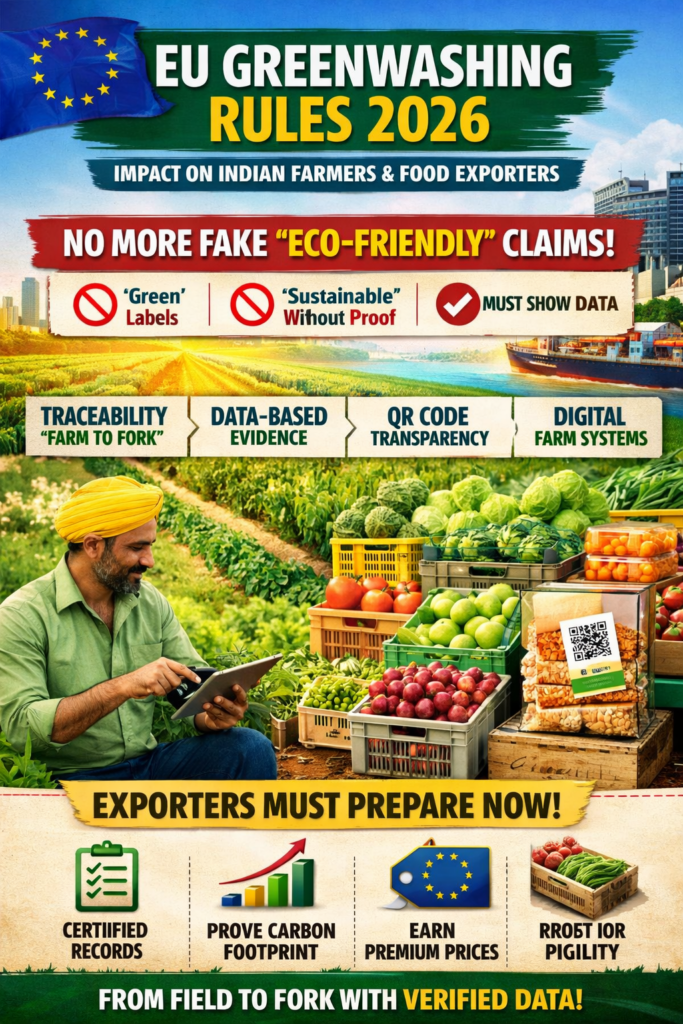
EU Greenwashing Rules 2026: Indian Farmers & Exporters Must Prepare Now
Introduction
The European Union (EU) is introducing strict new rules to eliminate “greenwashing”—the practice of making false or vague environmental claims. For agriculture and food exporters, this marks a major shift.
From 2026 onwards, simply labeling products as “eco-friendly” or “sustainable” will not be enough. Exporters must provide clear, verifiable data to support every claim.
This change will significantly impact Indian farmers, agri-export businesses, and food brands targeting the EU market.
What is Greenwashing and Why EU is Banning It?
Greenwashing happens when companies:
- Use terms like “natural”, “green”, or “climate-friendly”
- Without real proof or measurable data
Studies show that over 50% of environmental claims are misleading or unsupported
To protect consumers and ensure fair competition, the EU now requires:
- Scientific evidence
- Transparent communication
- Verified sustainability claims
Key Highlights of EU Greenwashing Rules (2026)
- ✅ Claims must be backed by scientific and measurable data
- ✅ Vague terms like “eco-friendly” without proof are banned
- ✅ Third-party verification may be required
- ✅ Labels must be clear and not misleading
- ✅ Full lifecycle impact (production to transport) may be assessed
This means data-driven proof is now mandatory, not optional
Impact on Indian Farmers & Exporters
1. Data-Driven Farming is Now Essential
Farmers must maintain proper records of:
- Fertilizer and pesticide usage
- Water consumption
- Soil health and crop practices
- Carbon footprint (if applicable)
2. Full Traceability (Farm to Fork)
Exporters must provide complete traceability:
- Farm origin of produce
- Harvesting and processing details
- Transportation and storage data
Buyers in the EU will demand complete transparency
3. Digital Tools Become Necessary
To meet compliance, businesses will need:
- Farm Management Software (FMS)
- ERP and supply chain systems
- Digital record-keeping platforms
Without digital documentation, export approvals may become difficult
4. Opportunity for Premium Pricing
Exporters who comply can:
- Build trust with EU buyers
- Access premium markets
- Get better pricing for verified sustainable products
Role of Technology in Compliance
Technology will play a key role in meeting EU standards:
✔ QR Code Transparency
- Consumers can scan and view product details
- Shows origin, certifications, and sustainability data
✔ Farm Management Systems
- Record daily farm activities
- Generate audit-ready reports
✔ Supply Chain Tracking
- Ensures product authenticity
- Improves trust and traceability
Challenges for Small Farmers
- Limited digital knowledge
- High initial setup cost
- Lack of awareness about EU rules
Possible solutions:
- Farmer Producer Organizations (FPOs)
- Agri-tech platforms
- Government schemes and training
How to Prepare for EU Market (Step-by-Step)
- Start maintaining digital farm records
- Adopt sustainable and certified practices
- Use approved inputs and documentation
- Implement traceability systems
- Partner with exporters or agri-tech companies
Conclusion
The EU’s new greenwashing rules are not just restrictions—they are an opportunity for Indian farmers and exporters.