How Precision Agriculture Helps Farmers Beat Rising Costs and Climate Stress
How Precision Agriculture Helps Farmers Beat Rising Costs and Climate Stress
Agriculture today is facing two major challenges: increasing production costs and unpredictable climate conditions. Farmers around the world are struggling with rising prices of fertilizers, pesticides, fuel, and seeds, while also dealing with irregular rainfall, droughts, heat waves, and pest outbreaks.
To overcome these challenges, many farmers are adopting precision agriculture, a modern farming approach that uses advanced technology and data to improve efficiency, reduce costs, and increase crop productivity.
Precision agriculture helps farmers make data-driven decisions, ensuring that crops receive the right amount of water, fertilizer, and protection at the right time and place. This approach not only boosts farm profitability but also supports sustainable and climate-resilient agriculture.
What Is Precision Agriculture?
Precision agriculture, also known as precision farming, is a technology-based farm management system that helps farmers monitor and manage crops more accurately.
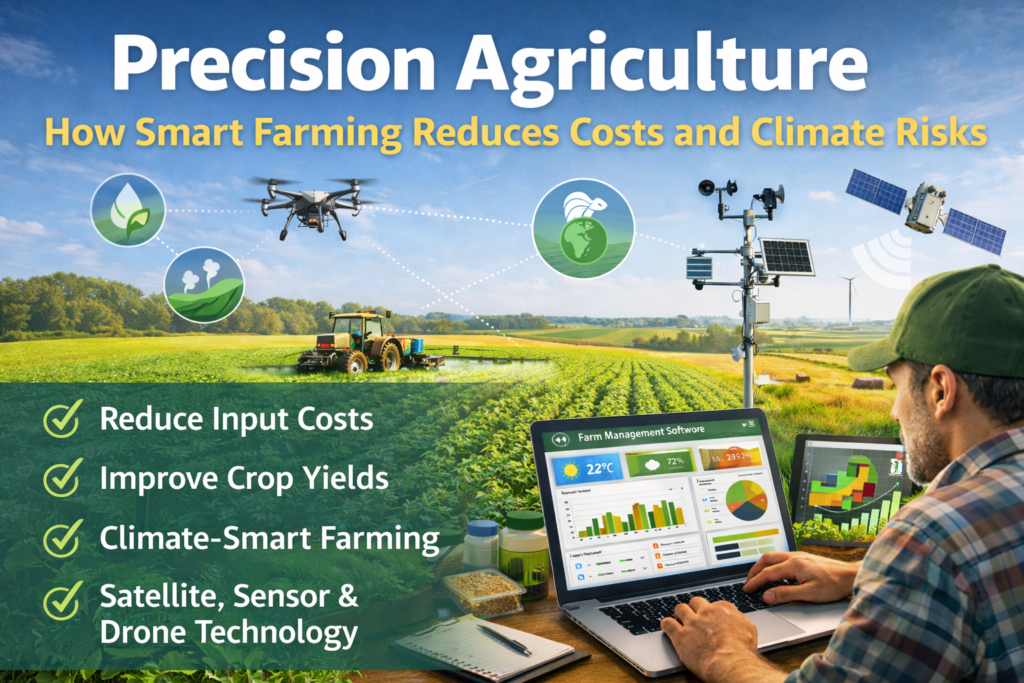
It uses modern tools such as:
-
Satellite imagery
-
GPS technology
-
Drones for crop monitoring
-
Soil moisture and nutrient sensors
-
Farm management software
-
Weather forecasting systems
These technologies collect real-time data from the field and convert it into actionable insights. Instead of treating the entire field the same way, precision agriculture identifies variations in soil fertility, moisture levels, and crop health.
This allows farmers to apply fertilizers, pesticides, seeds, and irrigation only where they are truly needed, improving efficiency and reducing waste.
Tackling Rising Input Costs
One of the biggest benefits of precision agriculture is its ability to reduce farming costs.
Traditional farming often involves uniform input application across entire fields, which can lead to over-use of fertilizers, pesticides, and water. Precision agriculture solves this problem by enabling site-specific crop management.
For example:
-
Fertilizers can be applied only in nutrient-deficient areas.
-
Pesticides can target pest-affected zones rather than the entire field.
-
Irrigation can be adjusted based on soil moisture levels.
Many farms also use Variable Rate Application (VRA) technology, which automatically adjusts the amount of fertilizer or seed applied across different parts of the field.
As a result, farmers can significantly reduce input costs while maintaining or even improving crop yields.
Improving Crop Health and Yield Stability
Climate change has increased the risk of crop stress caused by extreme weather conditions, pest outbreaks, and nutrient deficiencies.
Precision agriculture helps farmers detect crop problems earlier using satellite images and vegetation indices such as NDVI (Normalized Difference Vegetation Index). These technologies reveal plant stress before it becomes visible to the human eye.
Early detection allows farmers to:
-
Identify pest or disease outbreaks quickly
-
Monitor crop growth patterns
-
Detect water stress or nutrient deficiencies
-
Take corrective action before damage spreads
This proactive approach leads to healthier crops and more stable yields even in unpredictable seasons.
Supporting Climate-Smart and Sustainable Farming
Modern agriculture must balance productivity with environmental protection. Precision agriculture supports climate-smart farming practices that help reduce the environmental impact of farming.
Some of the environmental benefits include:
-
Reduced fertilizer runoff into rivers and groundwater
-
Lower greenhouse gas emissions from excessive nitrogen use
-
Efficient water usage through smart irrigation systems
-
Reduced chemical use due to targeted crop protection
By improving input efficiency, precision farming allows farmers to increase production while protecting soil and natural resources.
Role of Farm Management Software
Farm management software plays a central role in precision agriculture. It acts as the digital control center of the farm, bringing together data from multiple sources into one platform.
Farmers can use this software to:
-
Track field activities and crop performance
-
Monitor weather conditions and soil data
-
Manage input costs and farm budgets
-
Analyze productivity across different seasons
By organizing and analyzing farm data, the software helps farmers make smarter decisions that improve farm efficiency and profitability.
Why Precision Agriculture Matters for Small and Medium Farmers
Precision agriculture is often associated with large commercial farms, but today many technologies are becoming affordable and accessible for small and medium farmers.
For example:
-
Satellite-based crop monitoring services are now widely available.
-
Mobile apps allow farmers to track field data easily.
-
Cooperatives and agricultural advisory services provide shared access to precision tools.
Even basic digital tools can help farmers reduce input costs, improve crop management, and adapt better to climate variability.
As farming becomes more technology-driven, precision agriculture will play an important role in helping farmers build resilient and profitable farming systems.
Conclusion
Precision agriculture is transforming the future of farming by combining technology, data, and sustainable practices. By using tools such as satellite monitoring, drones, sensors, and farm management software, farmers can manage their fields more efficiently than ever before.
This modern approach helps farmers reduce input costs, improve crop yields, and adapt to climate challenges, making agriculture more profitable and environmentally sustainable.
As technology continues to evolve, precision agriculture will become an essential tool for farmers who want to stay competitive in modern agriculture.