
Plant Residue Management: Turning Farm Waste into Soil Wealth
Plant Residue Management: Turning Farm Waste into Soil Wealth
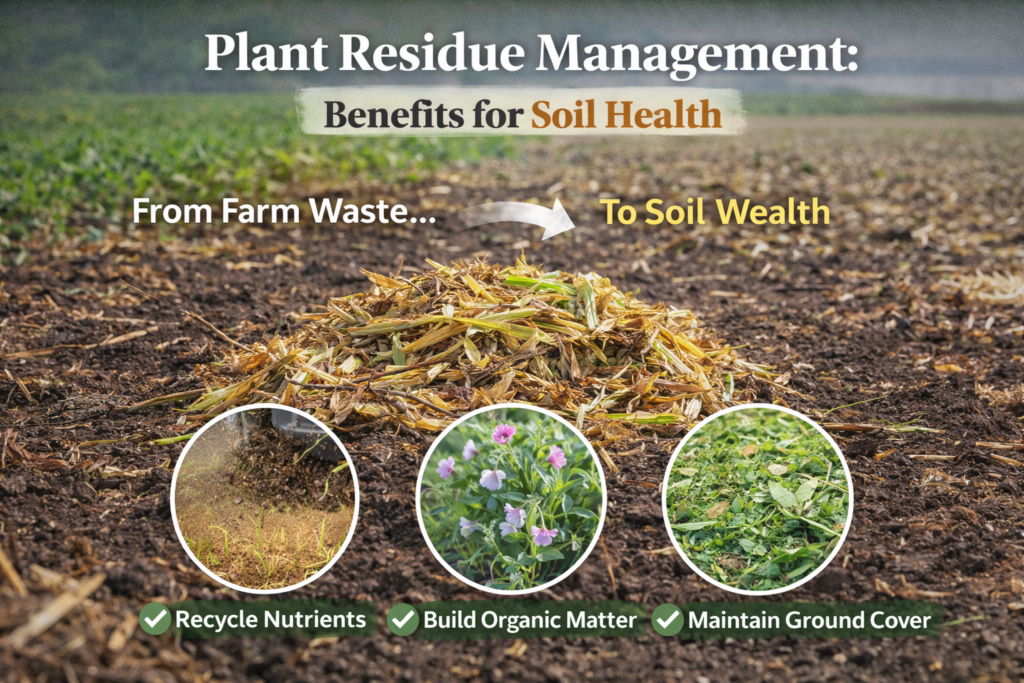
Plant residue management plays an important role in sustainable agriculture. After harvesting crops, a large amount of plant material such as stalks, leaves, stems, and roots remains in the field. Instead of treating these residues as waste, farmers can use them as a valuable resource to improve soil health and fertility.
Proper management of crop residues helps recycle nutrients, increase soil organic matter, and enhance long-term soil productivity. By using residues wisely, farmers can reduce fertilizer costs while maintaining a healthier agricultural ecosystem.
What Is Plant Residue Management?
Plant residue management refers to the practice of utilizing leftover crop materials in a way that benefits soil and crop production. These residues may include crop stalks, straw, leaves, husks, and root remains left after harvest.
When residues are returned to the soil or used as surface cover, they gradually decompose and release nutrients back into the soil. This process enriches the soil with organic matter and improves its physical, chemical, and biological properties.
Effective residue management is therefore a key component of modern conservation agriculture and sustainable farming systems.
Why Burning Crop Residues Is Harmful
In many farming regions, crop residues are often burned to quickly clear fields for the next crop. While this practice saves time in the short term, it causes serious damage to soil health and the environment.
Burning crop residues leads to:
-
Loss of valuable organic matter that could improve soil fertility
-
Destruction of beneficial soil microorganisms
-
Loss of essential nutrients such as nitrogen, sulfur, and phosphorus
-
Increased air pollution and greenhouse gas emissions
Over time, repeated residue burning weakens soil structure, reduces water-holding capacity, and increases soil erosion. As a result, crop productivity may decline.
Effective Ways to Manage Plant Residues
Instead of burning residues, farmers can adopt several beneficial practices to improve soil quality.
Residue Incorporation into Soil
Bulky residues such as maize stalks or wheat straw can be chopped into smaller pieces and incorporated into the soil during land preparation. Mixing residues with soil at a depth of 20–30 cm promotes faster decomposition and formation of humus.
Applying Nitrogen Fertilizer
Crop residues often have a high carbon content. When microbes decompose these materials, they require nitrogen. Applying a small amount of nitrogen fertilizer, such as urea, helps accelerate decomposition and prevents temporary nitrogen deficiency in crops.
Maintaining Residue Cover
In conservation agriculture systems, residues are left on the soil surface to act as mulch. This protective layer reduces soil erosion, conserves moisture, and moderates soil temperature.
Role of Carbon–Nitrogen Ratio in Residue Decomposition
The carbon-to-nitrogen (C/N) ratio is an important factor in the decomposition of crop residues. Microorganisms that break down organic matter use carbon as an energy source and nitrogen for growth.
When residues with a high C/N ratio are added to the soil, microbes may temporarily use available soil nitrogen for decomposition. This can reduce nitrogen availability for crops.
To maintain balance, farmers often apply nitrogen fertilizers along with residues. This helps microorganisms decompose residues efficiently while ensuring that crops receive sufficient nutrients.
During decomposition, part of the organic material is converted into humus, which improves soil structure, water retention, and nutrient availability.
Importance of Green Manuring
Green manuring is another effective method for improving soil organic matter. In this practice, farmers grow specific crops and incorporate them into the soil before flowering.
Common green manure crops include:
-
Legumes such as clover, vetch, and lupine
-
Mustard and oilseed radish
-
Buckwheat and phacelia
These crops enrich the soil with organic matter, improve soil structure, and stimulate beneficial microbial activity.
On heavy soils, green manure improves aeration and drainage, while on sandy soils it increases water-holding capacity and nutrient retention.
Environmental and Economic Benefits
Proper plant residue management provides several advantages for farmers and the environment.
It helps reduce soil erosion by protecting the soil surface from rainfall impact. Recycling crop residues also improves nutrient efficiency, which can reduce the need for expensive chemical fertilizers.
Additionally, better soil organic matter improves soil fertility, crop resilience, and long-term farm productivity.
By adopting sustainable residue management practices, farmers contribute to soil conservation, climate protection, and sustainable agricultural development.
Conclusion
Plant residue management is a simple yet powerful practice for improving soil health and agricultural sustainability. Instead of burning crop residues, farmers can recycle them through incorporation, mulching, or green manuring.
These practices not only improve soil fertility but also support long-term productivity and environmental protection. Treating crop residues as a valuable resource rather than waste can transform farm fields into healthier and more sustainable production systems.