
Weeds as Natural Indicators of Soil Health: A Practical Guide for Farmers
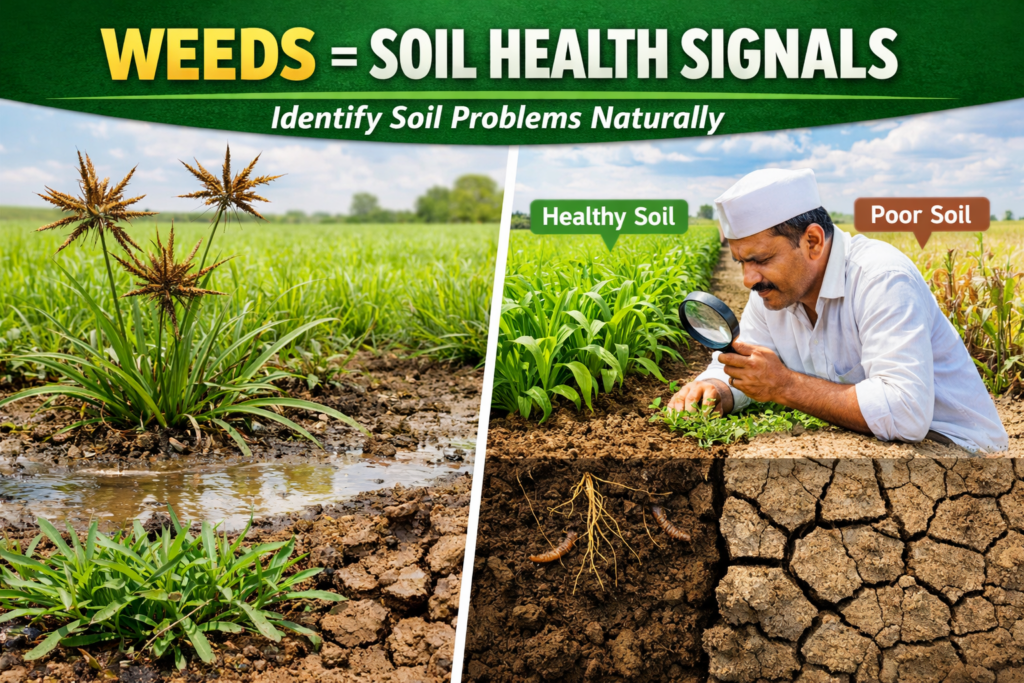
Weeds as Natural Indicators of Soil Health: A Practical Guide for Farmers
Farmers usually consider weeds as unwanted plants that compete with crops. However, many weeds serve as natural indicators of soil health. By observing which weeds dominate a field, farmers can identify soil problems such as acidity, poor drainage, compaction, and nutrient imbalance — without expensive laboratory testing.
Understanding these natural signals can help reduce input costs and improve crop productivity.
What Does It Mean When Weeds Act as Soil Indicators?
Certain weed species grow only under specific soil conditions. Their presence reveals important information about:
-
Soil pH (acidic or alkaline)
-
Soil fertility and nutrient balance
-
Moisture and drainage conditions
-
Soil structure and compaction
By identifying dominant weed species, farmers can decide whether to improve drainage, add lime, loosen compact soil, or adjust fertilizer application.
Soil Conditions Indicated by Common Weeds
1. Acidic or Alkaline Soil
Indicator Weeds:
-
Dandelion – grows well in acidic soils with low lime levels
-
Fat hen (Chenopodium album) – indicates fertile, alkaline soils and excess nitrogen
What it means:
Check soil pH levels. Apply lime in acidic soils or reduce nitrogen fertilization where excess nutrients are present.
2. Poor Drainage and Waterlogging
Indicator Weed:
-
Field horsetail – common in waterlogged, compact, heavy soils
What it means:
Improve field drainage and avoid machinery movement when soil is wet to prevent further compaction.
3. High Fertility and Rich Organic Matter
Indicator Weed:
-
Stinging nettle – thrives in moist, nutrient-rich, humus-rich soils
What it means:
Fertility is already high. Focus on balanced nutrient management instead of adding more manure or fertilizers.
4. Soil Compaction and Heavy Clay Soil
Indicator Weed:
-
Creeping thistle – occurs in compact clay soils with excess nitrogen and wet conditions
What it means:
Loosen soil through deep tillage, improve aeration, and add organic matter to enhance soil structure.
Indicator Weeds in Indian & Maharashtra Conditions
In black cotton soils (Vertisols) common in Maharashtra, some weeds provide valuable soil clues:
-
Cynodon dactylon (Bermuda grass / Harali)
→ indicates soil compaction and hard surface layers -
Cyperus rotundus (Nutgrass / Nagarmotha)
→ indicates heavy clay soil and excess moisture
These weeds signal structural problems and poor drainage before crop damage becomes visible.
How Farmers Can Diagnose Soil Using Weeds
Farmers can use weeds as a quick field diagnostic tool by following these steps:
✔ Walk through the field and observe dominant weed species
✔ Focus on weeds covering more than 15% of the area
✔ Check soil texture, moisture, and compaction
✔ Compare observations with Soil Health Card results
✔ Consult Krishi Vigyan Kendras for expert advice
Important: Do not rely on a single weed species. Observe multiple dominant weeds for accurate diagnosis.
Benefits of Using Weeds as Soil Health Indicators
✅ Detect soil problems early
✅ Reduce unnecessary fertilizer use
✅ Improve soil structure and fertility
✅ Save money on soil testing
✅ Support sustainable farming practices
Conclusion
Weeds are more than just crop competitors — they are living indicators of soil health. Learning to interpret these natural signals allows farmers to identify soil problems early and take corrective action.
When combined with soil testing and scientific recommendations, weed observation becomes a powerful, low-cost tool for maintaining healthy soil and improving crop productivity.