
Intensive Farming vs. Soil Humus: Can We Protect Soil While Producing More Food?
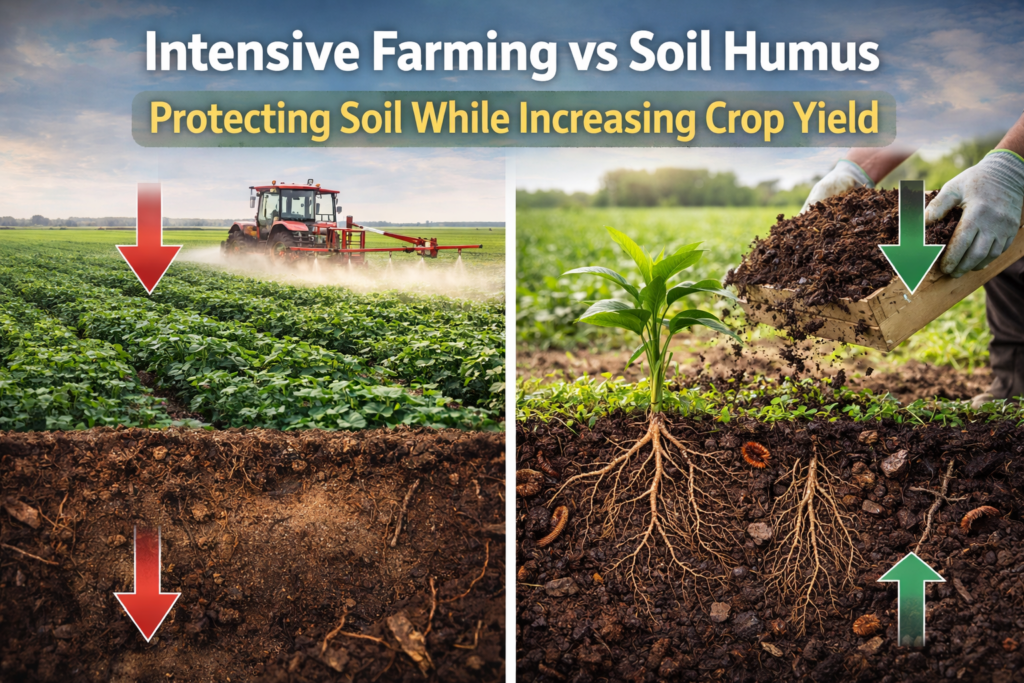
Intensive Farming vs. Soil Humus: Can We Protect Soil While Producing More Food?
Modern agriculture often pursues maximum productivity, yet this high-intensity approach can gradually erode one of farming’s most valuable assets: soil humus. Humus is the dark, stable organic component of soil that underpins fertility, water retention, and long-term productivity.
What Is Humus and How Does It Form?
Humus is the final, stable product of organic matter decomposition in soil. When plant residues, crop roots, animal manure, and other organic materials enter the soil, microorganisms such as bacteria and fungi break them down through a process known as humification. During this transformation, complex organic compounds become dark, carbon-rich substances that may remain in the soil for decades — or even centuries.
This well-decomposed material gives soil its dark color and crumbly structure. Humus can retain large amounts of water — often close to its own weight — helping soil remain moist for longer periods. At the same time, it binds essential nutrients such as nitrogen, phosphorus, and calcium, acting as a slow-release nutrient reservoir for crops.
Key Functions and Benefits of Humus
Humus plays a vital role in maintaining healthy and productive soil. Its major benefits include:
-
Improved soil structure — promotes stable aggregates, making soil friable and easier for roots to penetrate.
-
Enhanced microbial life — supports beneficial rhizobacteria and mycorrhizal fungi that improve nutrient and water uptake.
-
Greater water-holding capacity — reduces irrigation needs and helps crops withstand short dry spells.
-
Nutrient retention and buffering — prevents nutrient leaching and ensures gradual nutrient release.
-
Faster soil warming — dark humus absorbs heat, helping soils warm earlier and promoting early crop growth.
Simply put, humus-rich soils are more resilient, easier to manage, and capable of sustaining high yields over the long term.
How Intensive Farming Reduces Humus Levels
Intensive farming systems aim for high output through frequent cropping, heavy tillage, and extensive use of mineral fertilizers and agrochemicals. While these methods can increase short-term yields, they often accelerate the breakdown of organic matter.
Repeated deep ploughing exposes soil organic matter to oxygen, stimulating microbial activity and speeding up decomposition. Over time, humus levels decline, leading to:
-
Soil compaction and crust formation
-
Reduced porosity and root penetration
-
Lower water infiltration and retention
-
Increased erosion risk
-
Declining biological activity
As humus decreases, farmers often require higher amounts of synthetic fertilizers to maintain yields because the soil’s natural nutrient-holding capacity weakens.
Thus, although intensive systems may appear productive in the short term, they can undermine soil health if humus is not replenished.
Strategies to Rebuild and Protect Humus
The goal is not to reduce productivity but to combine intensive production with conscious humus management. Practical strategies include:
-
Applying organic manures such as farmyard manure, compost, slurry, or biogas digestate.
-
Growing cover crops and green manures to maintain living roots and add biomass.
-
Practicing crop rotation instead of monocropping to enhance organic inputs and break pest cycles.
-
Reducing tillage to minimize disturbance and slow humus loss.
-
Integrating trees and shrubs (agroforestry) to add organic litter and long-term carbon inputs.
Modern farm management tools can also help optimize the timing and quantity of organic inputs, improving soil health while maintaining productivity.
Balancing Yield with Soil Health
In the coming decades, agriculture must produce more food while using land and water efficiently. Preserving and enhancing soil humus is one of the most effective ways to achieve this balance, as it supports both productivity and environmental sustainability.
Intensive farming does not have to mean depleting the soil. With thoughtful humus management, it can evolve into a system that maintains fertility, reduces dependence on external inputs, and ensures stable production for future generations.