Cost Per Hectare: The Key to Profitable Farming
Cost Per Hectare: The Key to Profitable Farming
In modern agriculture, understanding the true cost of production per hectare is essential for improving profitability and sustainability. Many farmers still rely on basic records that only include major expenses like seeds and fertilizers. However, this approach often leads to incomplete insights and poor decision-making.
Why Traditional Tracking Falls Short
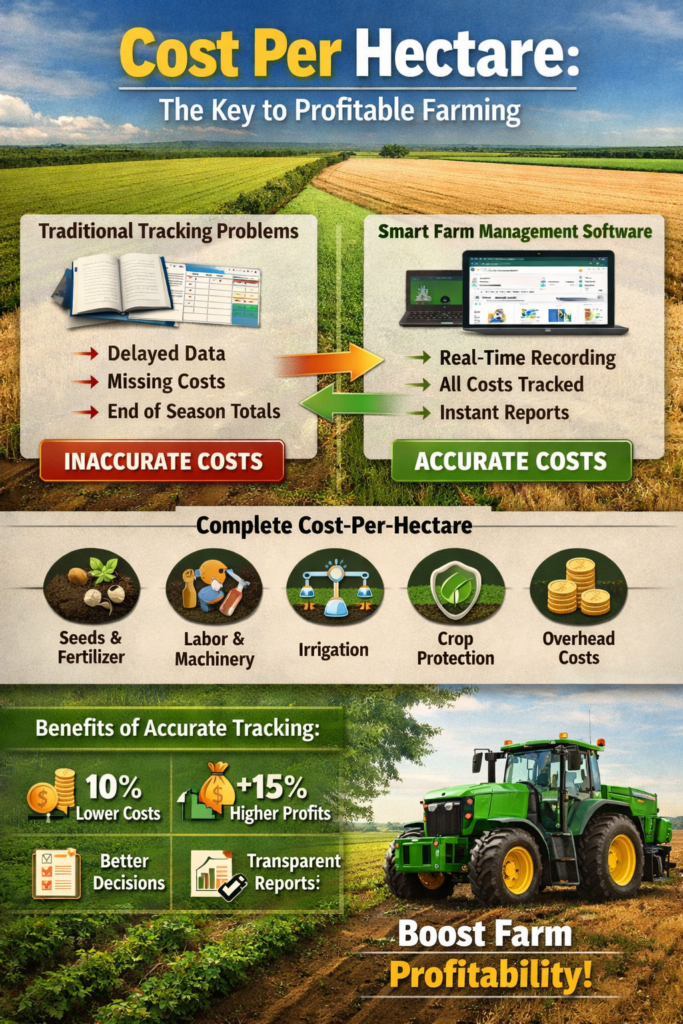
Most farmers maintain records in notebooks or spreadsheets. While these methods are simple, they come with major limitations:
- Data is recorded late or in batches
- Many costs are missed or estimated
- Real expenses become visible only after the season ends
Because of this delay, farmers cannot correct mistakes during the crop cycle, which directly impacts profits.
What Should Be Included in Cost Per Hectare?
A true cost-per-hectare calculation must include all expenses related to farming operations, such as:
- Seeds and fertilizers
- Labor costs
- Machinery and equipment usage
- Irrigation expenses
- Crop protection inputs
- Overhead and miscellaneous costs
Only by considering all these factors can farmers understand the actual cost of production.
The Role of Farm Management Software
Modern tools like farm management systems are transforming how farmers track costs. These platforms record every farm activity in real time and automatically calculate expenses per field and crop.
One such solution, AGRIVI FMS 360, enables farmers to:
- Record activities instantly
- Track input usage accurately
- Generate real-time cost-per-hectare reports
- Compare field-wise profitability
Proven Benefits of Digital Cost Tracking
Studies highlighted by Agrivi show that using farm management software can:
- Reduce total farming costs by around 10%
- Increase profitability by up to 15%
- Minimize errors in cost tracking
- Improve input efficiency
How Accurate Cost Data Helps Farmers
When farmers have precise cost-per-hectare data, they can:
- Identify high-cost and low-profit fields
- Control unnecessary expenses
- Make better crop planning decisions
- Justify investments in new technology
- Provide transparent reports to partners and stakeholders
Conclusion
Cost-per-hectare is not just a number—it is the foundation of smart farming decisions. By shifting from delayed manual records to real-time digital tracking, farmers can gain full control over their expenses and significantly improve profitability.