Climate Change and Its Growing Impact on Agriculture
Climate Change and Its Growing Impact on Agriculture
Agriculture is one of the sectors most closely connected to nature, and therefore it is highly sensitive to changes in climate. Over the past few decades, climate change has become a serious global concern, affecting farming systems, crop productivity, water availability, and food security. Rising temperatures, unpredictable rainfall patterns, and more frequent extreme weather events are already changing how farmers grow crops and manage their fields.
For millions of farmers around the world, especially small-scale farmers, adapting to climate change has become essential for survival. Understanding how climate change influences agriculture can help farmers adopt better practices and technologies to protect their crops and livelihoods.
Rising Temperatures and Their Effect on Crops
One of the most noticeable impacts of climate change is the gradual rise in global temperatures. Crops grow best within a certain temperature range, and when temperatures exceed this range, plant growth can slow down and yields can decline.
Heat stress during crucial growth stages such as flowering and pollination can significantly reduce crop production. For example, crops like wheat, maize, and rice are particularly sensitive to high temperatures during these stages. Even a small increase in temperature can lead to lower grain formation and reduced harvests.
Higher temperatures also increase evaporation rates, which leads to faster soil moisture loss. As a result, crops require more water to survive, putting additional pressure on irrigation systems and water resources.
Increase in Pests, Diseases, and Weeds
Climate change also creates favorable conditions for pests and plant diseases. Warmer temperatures allow insects and pathogens to survive longer and spread into new regions where they previously could not thrive.
Many pests are now completing more life cycles within a single growing season. This increases crop damage and forces farmers to use more pesticides and chemical controls. While these measures may protect crops in the short term, they also increase production costs and can harm the environment if not managed properly.
Similarly, weeds grow faster in warmer climates and compete with crops for nutrients, sunlight, and water. This can further reduce crop yields and increase the need for weed management.
Extreme Weather Events and Crop Damage
Climate change has also increased the frequency and intensity of extreme weather events such as droughts, floods, storms, and heatwaves.
Heavy rainfall can cause soil erosion, nutrient loss, and root damage, while floods can destroy entire crops within hours. On the other hand, prolonged droughts reduce water availability and make it difficult for crops to grow properly.
Unpredictable rainfall patterns also create challenges for farmers when planning planting and harvesting schedules. Traditional farming calendars are becoming less reliable as seasons shift and weather patterns become more uncertain.
Water Scarcity and Irrigation Challenges
Water is one of the most critical resources in agriculture. Climate change is affecting water availability by altering rainfall distribution and increasing evaporation rates.
Many regions are experiencing irregular rainfall, meaning that farmers cannot rely on consistent rainy seasons anymore. In dry areas, groundwater levels are also declining due to increased demand for irrigation.
Farmers must therefore adopt more efficient irrigation techniques such as drip irrigation, sprinkler systems, and rainwater harvesting to conserve water and maintain crop productivity.
Agriculture’s Contribution to Climate Change
While agriculture is heavily affected by climate change, it also contributes to the problem. Activities such as livestock production, fertilizer use, and land-use changes release greenhouse gases like methane and nitrous oxide into the atmosphere.
Globally, agriculture and land use together contribute a significant portion of greenhouse gas emissions. This means that the agricultural sector must focus not only on adapting to climate change but also on reducing its environmental impact.
Sustainable farming practices such as crop rotation, conservation tillage, improved manure management, and efficient fertilizer use can help lower emissions while maintaining soil health and productivity.
Climate-Resilient Farming Practices
To deal with the challenges of climate change, farmers are increasingly adopting climate-resilient agricultural practices. These include using drought-tolerant crop varieties, improving soil health, and diversifying cropping systems.
Healthy soil plays a key role in climate resilience. Practices such as organic farming, cover cropping, and reduced tillage help improve soil structure and increase its ability to retain water and nutrients.
Crop diversification is another important strategy. By growing different crops, farmers can reduce the risk of losing their entire harvest due to unfavorable weather conditions.
Role of Digital Technology in Modern Agriculture
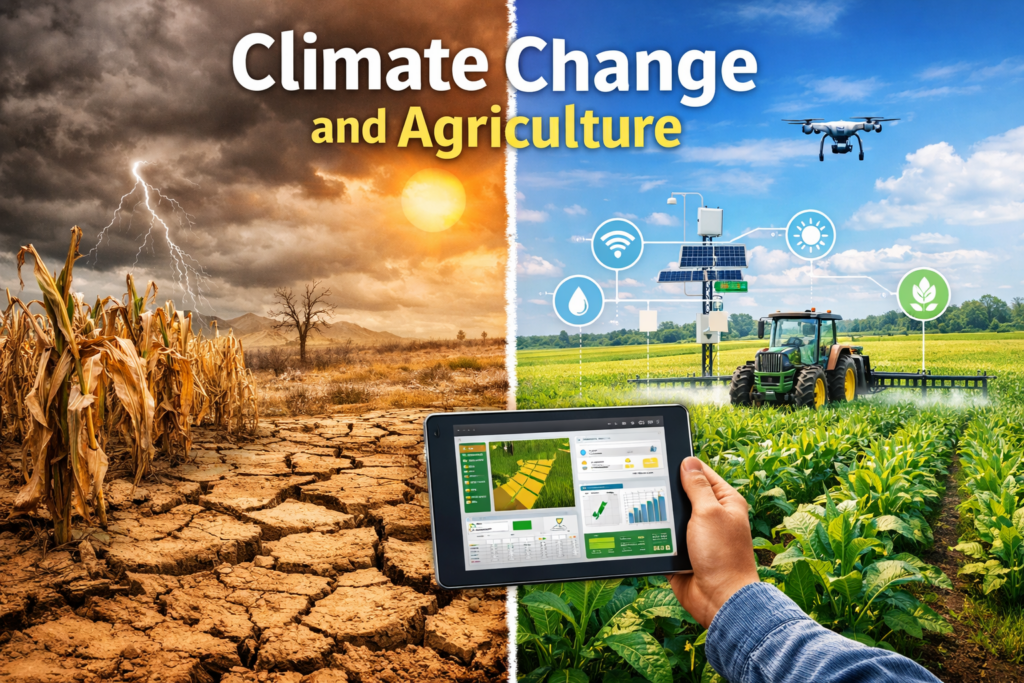
Digital agriculture is becoming an important tool in helping farmers adapt to climate change. Technologies such as farm management software, satellite monitoring, and weather forecasting tools allow farmers to make data-driven decisions.
Farm management platforms enable farmers to track field activities, monitor crop health, and plan irrigation, fertilization, and pest control more efficiently. With accurate data, farmers can reduce unnecessary input use, lower production costs, and improve overall productivity.
Digital tools also help farmers respond quickly to changing weather conditions, making agriculture more resilient and sustainable.
The Future of Climate-Smart Agriculture
Climate change will continue to influence agriculture in the coming decades, making it essential for farmers, researchers, and policymakers to work together.
Governments must invest in agricultural research, climate-resilient crop varieties, and farmer training programs. Extension services should provide farmers with the knowledge and tools needed to adapt to changing environmental conditions.
By combining traditional farming knowledge with modern technologies and sustainable practices, agriculture can remain productive while protecting natural resources for future generations.
Climate-smart agriculture is not just an option—it is becoming a necessity for ensuring global food security in a changing world.