ROI of AI Advisory in Agriculture: A Complete Guide for Agribusiness
ROI of AI Advisory in Agriculture: A Complete Guide for Agribusiness
Introduction
Agriculture is rapidly evolving with the integration of digital technologies, and Artificial Intelligence (AI) is leading this transformation. AI-powered advisory systems are helping farmers make informed decisions based on real-time data, weather patterns, soil conditions, and crop health.
For agrifood companies, AI advisory is not just a technological upgrade—it is a powerful business tool that delivers measurable Return on Investment (ROI). This blog explores how AI advisory creates value, improves farmer engagement, and boosts business growth.
What is AI Advisory in Agriculture?
AI advisory refers to digital platforms or tools that provide farmers with personalized recommendations. These systems use technologies like machine learning, satellite data, and predictive analytics to guide farmers on:
- Crop selection and planning
- Pest and disease management
- Irrigation scheduling
- Fertilizer usage
- Market price insights
These recommendations are often delivered via mobile apps, chatbots, SMS, or voice-based systems.
Why ROI Matters in Agribusiness
Agribusiness companies invest heavily in farmer outreach, field visits, and marketing campaigns. Measuring ROI helps them understand:
- How effectively they are reaching farmers
- Whether engagement is meaningful
- If interactions are converting into actual sales
AI advisory provides clear, trackable metrics that go beyond traditional marketing performance.
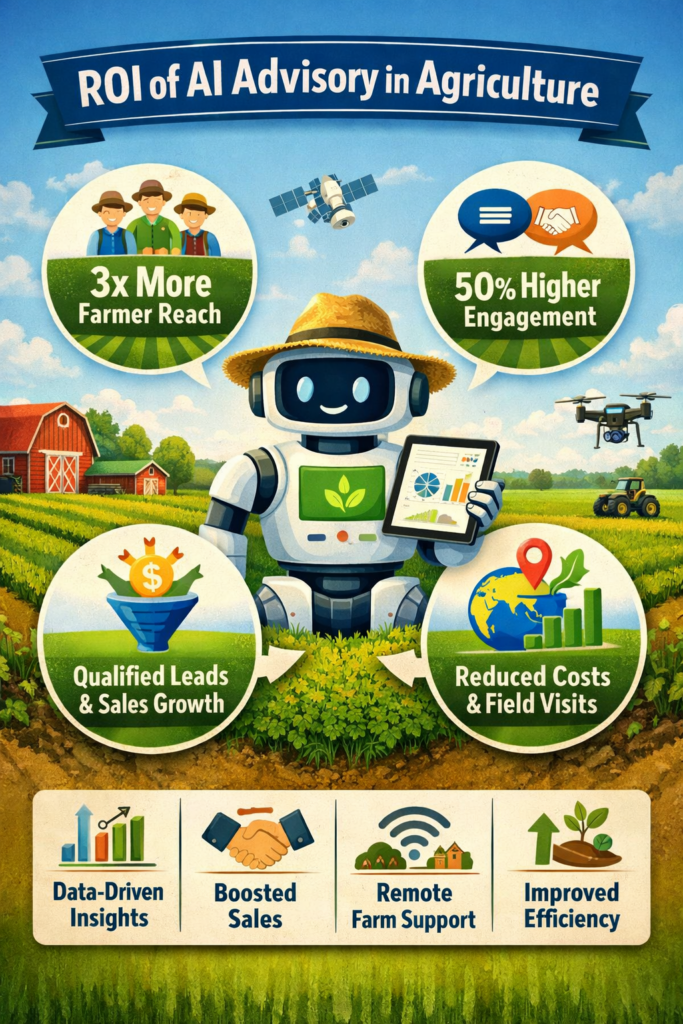
Key Ways AI Advisory Delivers ROI
1. Increased Farmer Reach
AI advisory tools can connect with a large number of farmers simultaneously. Unlike traditional field officers who are limited by time and geography, digital platforms can scale rapidly.
Companies can reach 3x more farmers without increasing their workforce.
2. Better Farmer Engagement
AI tools enable continuous communication with farmers through personalized messages, reminders, and updates.
- Regular interaction builds trust
- Farmers feel supported throughout the crop cycle
- Engagement levels can increase by 50% or more
3. Lead Generation and Sales Growth
When farmers interact with advisory platforms, they often:
- Ask about product prices
- Compare solutions
- Request demonstrations or meetings
These actions act as high-quality sales leads, helping companies convert interest into revenue.
4. Cost Efficiency
Traditional farming advisory relies on physical visits, which are time-consuming and expensive. AI reduces:
- Travel costs
- Labor expenses
- Time spent per farmer
This makes it possible to serve remote and low-margin regions profitably.
5. Data-Driven Decision Making
AI platforms collect valuable data such as:
- Farmer preferences
- Crop patterns
- Buying behavior
This data helps companies:
- Improve product offerings
- Optimize marketing strategies
- Predict demand more accurately
Real-World Impact of AI Advisory
Agrifood companies using AI advisory systems are experiencing:
- Faster customer acquisition
- Stronger farmer relationships
- Higher conversion rates
- Improved operational efficiency
Over time, dashboards and analytics tools make it easy to track these improvements and clearly demonstrate ROI.
Challenges to Consider
While AI advisory offers many benefits, companies should also address:
- Digital literacy among farmers
- Internet connectivity in rural areas
- Data accuracy and reliability
- Language and regional customization
Overcoming these challenges ensures better adoption and long-term success.
Future of AI in Agriculture
The future of AI advisory looks promising with advancements such as:
- Voice-based assistants in local languages
- Integration with IoT devices and sensors
- Real-time crop monitoring using drones
- Predictive analytics for climate risks
These innovations will further increase ROI and make farming more efficient and sustainable.
Conclusion
AI advisory is revolutionizing agriculture by bridging the gap between technology and farmers. For agribusinesses, it offers a clear path to higher ROI through increased reach, better engagement, and cost-effective operations.
Companies that adopt AI advisory today are not only improving their bottom line but also contributing to a smarter, more sustainable agricultural ecosystem.