EU Greenwashing Rules: New Era of Food Transparency
EU Greenwashing Rules: New Era of Food Transparency
Introduction
In recent years, consumers have become more conscious about what they eat and how it is produced. To protect buyers from misleading environmental claims, the European Union has introduced strict regulations under the Greenwashing Directive.
This new rule ensures that all “eco-friendly” or “sustainable” claims on food products are clear, verified, and trustworthy.
What is Greenwashing?
Greenwashing refers to false or exaggerated environmental claims made by companies to attract customers.
For example:
- Using terms like “natural” or “eco-friendly” without proof
- Claiming sustainability without data
- Misleading packaging or labels
The EU aims to eliminate such practices and promote honest communication in the food industry.
Key Features of EU Greenwashing Rules
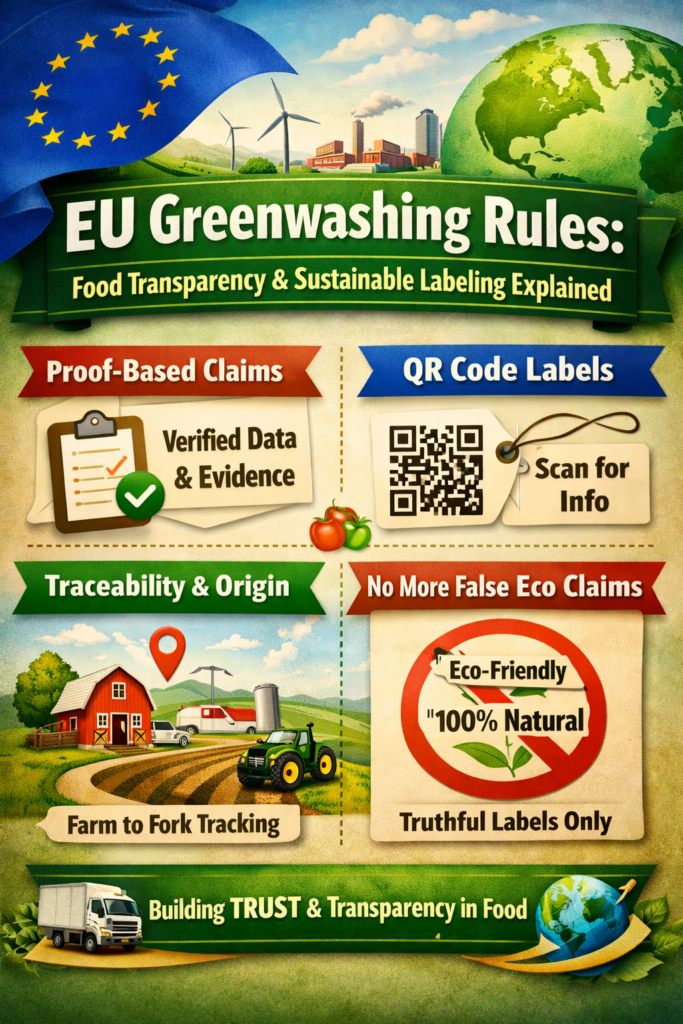
1. Proof-Based Claims
All environmental claims must be backed by scientific evidence and verified data.
2. Regular Updates
Companies must update their sustainability data every 5 years to maintain accuracy.
3. Digital Transparency
Consumers can access product information through:
- QR codes
- Labels
- Official websites
4. Full Product Information
Details that must be shared:
- Product origin
- Farming practices
- Inputs (fertilizers, pesticides)
- Quality and safety standards
Importance of Traceability in Agriculture
Traceability is becoming a powerful tool in modern agriculture. It allows tracking of food products from farm to consumer.
Benefits of Traceability Tools:
- 📍 Track complete production history
- 🔍 Ensure transparency
- 📦 Improve supply chain management
- 📲 Generate QR-based product data
This builds consumer trust and brand credibility.
Benefits for Farmers & Agribusiness
Adapting to these new EU rules can bring several advantages:
- Better trust among consumers
- Higher product value in global markets
- Easier export to European countries
- Compliance with future regulations
Farmers and agribusinesses adopting digital tools early will stay ahead in competition.
Future of Food Transparency
The EU Greenwashing Directive marks a major shift toward honest and sustainable food systems.
In the future:
- Transparency will be mandatory
- Digital traceability will be standard
- Consumers will demand proof, not promises