
Permaculture Farming: A Sustainable Path for the Future of Agriculture
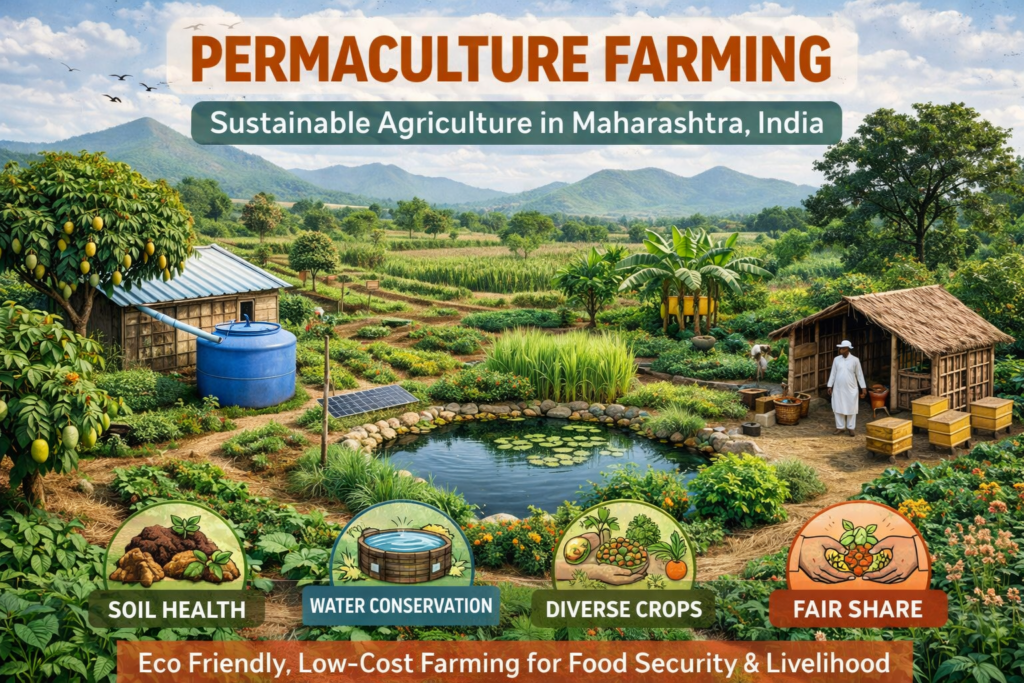
Permaculture Farming: A Sustainable Path for the Future of Agriculture
Agriculture across the world is facing serious challenges—declining soil fertility, unpredictable rainfall, rising input costs, and increasing pressure on water resources. In India, and especially in states like Maharashtra, these challenges are becoming more visible every year. Permaculture offers a practical and long-term solution by redesigning farms to work with nature instead of against it.
Permaculture is not just a farming method; it is a complete system of ecological design that helps farmers grow food sustainably while restoring soil, conserving water, and supporting biodiversity.
What Is Permaculture?
Permaculture is a design approach that imitates natural ecosystems to create productive and self-sustaining agricultural systems. Instead of relying heavily on chemical fertilizers, pesticides, and constant external inputs, permaculture focuses on natural cycles, local resources, and smart planning.
In nature, forests grow without fertilizers or pesticides, yet they remain productive for centuries. Permaculture applies similar principles to farms, gardens, and rural landscapes so they stay fertile and productive over the long term.
Why Permaculture Is Important Today
Modern intensive farming often depends on monocropping and heavy chemical use. While this may increase short-term yields, it can slowly damage soil structure, reduce organic matter, and increase vulnerability to droughts and pests.
Permaculture addresses these problems by:
-
Improving soil health naturally
-
Reducing dependency on costly inputs
-
Conserving water and energy
-
Creating resilient farming systems
For small and marginal farmers, this approach can reduce financial risk while improving long-term farm stability.
The Three Ethics of Permaculture
Permaculture is built on three core ethics that guide every design decision.
1. Care for the Earth
This means protecting soil, water, forests, and all living organisms. Healthy soil is the foundation of farming. Practices such as mulching, composting, green manuring, and reduced tillage help restore soil life and fertility.
2. Care for People
Farming should support healthy livelihoods and nutritious food. Permaculture systems aim to provide diverse crops, stable income sources, and safe working conditions for farmers and rural communities.
3. Fair Share (Return the Surplus)
This principle encourages reducing waste and sharing excess resources. Composting farm waste, saving seeds, and sharing knowledge within communities are simple but powerful examples.
Key Permaculture Design Principles
Permaculture design uses practical principles that help turn ideas into action.
Observe and Interact
Before making changes, farmers study their land—soil type, slope, water flow, sunlight, and wind patterns. Good observation leads to better decisions and fewer mistakes.
Catch and Store Water
Rainwater is a valuable resource. Farm ponds, contour bunds, trenches, and rooftop rainwater harvesting help store water for dry periods and recharge groundwater.
Obtain a Yield
A sustainable farm must also be productive. Permaculture designs focus on multiple yields such as food, fodder, fuelwood, compost material, and income throughout the year.
Use Diversity
Mixed cropping, crop rotation, and tree integration reduce pest problems and improve resilience. Diversity ensures that if one crop fails, others can still provide income.
Produce No Waste
Crop residues, animal manure, kitchen waste, and leaf litter are converted into compost or mulch. In permaculture, waste is seen as a resource.
From Monoculture to Polyculture and Agroforestry
Many conventional farms grow a single crop over large areas. While easy to manage, monoculture systems are risky and often require heavy chemical inputs.
Permaculture promotes:
-
Polyculture: Growing multiple crops together so they support each other
-
Agroforestry: Integrating trees with crops or livestock
Examples suitable for Indian conditions include:
-
Pulses grown with cereals
-
Vegetables under fruit trees
-
Fodder grasses along field boundaries
These systems improve soil structure, reduce pests, and provide multiple income streams.
Permaculture in Maharashtra: Practical Benefits
Maharashtra has diverse agro-climatic zones, many of which face water scarcity and soil degradation. Permaculture practices such as mulching, contour farming, and tree-based systems help retain moisture and protect soil during dry spells.
Fruit trees like mango, guava, custard apple, and lemon can be integrated with seasonal crops to provide long-term income. Farm ponds and rainwater harvesting reduce dependence on borewells and tankers.
Role of Technology in Permaculture Farming
Although permaculture emphasizes natural processes, digital tools can support better planning and monitoring. Farm management software helps farmers track multiple crops, record expenses, plan irrigation, and respond to weather changes.
When used correctly, technology complements ecological farming by improving efficiency and decision-making without harming the environment.
Why Permaculture Is the Future of Sustainable Agriculture
With climate change, rising cultivation costs, and increasing pressure on natural resources, farming systems must become more resilient. Permaculture provides a clear framework that combines environmental care, economic stability, and social responsibility.
By shifting from short-term extraction to long-term regeneration, farmers can protect their land, secure their livelihoods, and leave healthy farms for future generations.
Conclusion
Permaculture is not a trend—it is a return to intelligent, nature-based farming supported by modern knowledge. For Indian farmers, especially in regions facing water and soil challenges, permaculture offers a sustainable and practical path forward.
By working with nature rather than against it, farmers can build resilient farms that remain productive, profitable, and environmentally balanced for years to come.