Budget vs Actual Farm Management Systems for Modern Agriculture
Budget vs Actual Farm Management Systems: Modern Financial Management for Smart Farming
Why Budget vs Actual Analysis Matters in Modern Agriculture
Modern agriculture is no longer limited to crop production alone. Rising input costs, labor expenses, fuel prices, fertilizer rates, and unpredictable weather conditions have made financial planning essential for every farmer. In this rapidly evolving agricultural landscape, a Budget vs Actual Farm Management System has become one of the most important tools for efficient farm management.
Traditionally, farmers tracked expenses manually using notebooks and paper records. However, digital Farm Management Software (FMS) now enables real-time tracking of farm expenses, income, and profitability. This helps farmers make informed decisions, reduce unnecessary costs, and improve overall farm performance.
What is a Budget vs Actual Farm Management System?
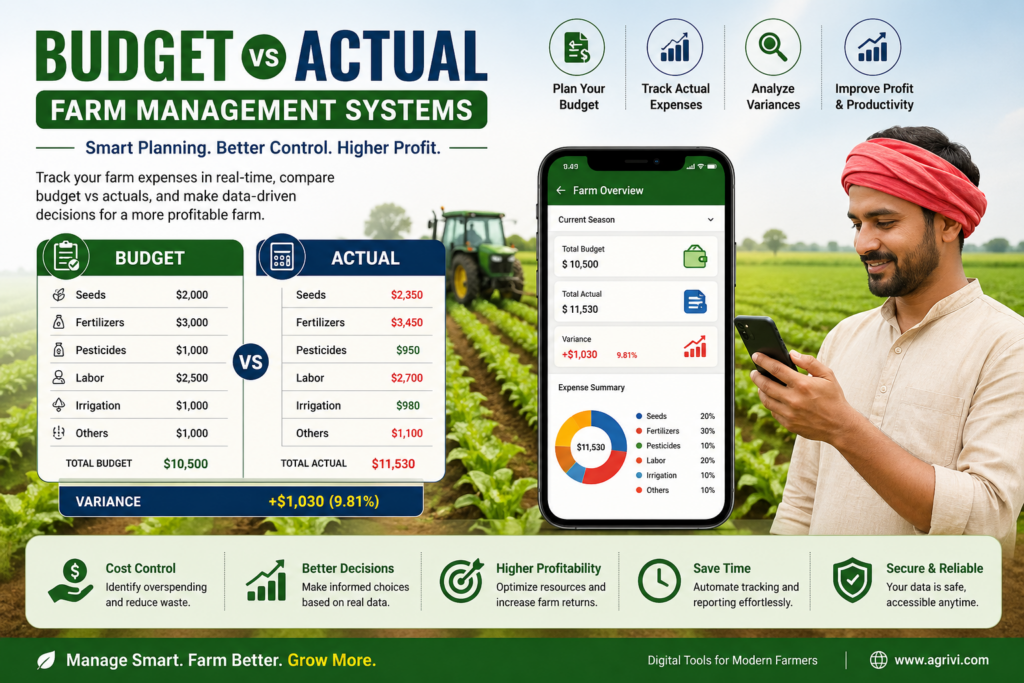
A Budget vs Actual Analysis compares planned farm expenses with actual spending during the farming season.
For example:
- Planned seed budget: $2,000
- Actual seed expense: $2,600
This comparison helps farmers identify where additional costs occurred and how spending impacts farm profitability.
The system typically analyzes:
- Seed costs
- Fertilizer expenses
- Pesticide and spraying costs
- Labor expenses
- Irrigation costs
- Fuel usage
- Production costs
- Market income and revenue
How Farm Management Software Helps Farmers
Modern farm management platforms such as AGRIVI provide farmers with digital tools for accurate financial monitoring and operational control.
Key Features of Farm Management Software
1. Real-Time Expense Tracking
Farmers can instantly record and monitor every farm-related expense.
2. Budget Planning
The software allows users to create detailed seasonal financial plans before farming operations begin.
3. Automated Financial Reports
Digital systems automatically generate financial and operational reports for better analysis.
4. Profitability Analysis
Farmers can identify which crops generate the highest returns and which operations reduce profitability.
5. Cost Control Alerts
The system provides alerts when spending exceeds the planned budget.
Benefits of Budget vs Actual Farm Management
Improved Financial Control
Farmers gain better visibility into operational spending and cash flow.
Reduced Unnecessary Expenses
Unexpected or excessive costs can be identified quickly and managed efficiently.
Better Decision-Making
Data-driven insights help farmers choose the most profitable crops and farming strategies.
Enhanced Future Planning
Historical farm data improves budgeting accuracy for future seasons.
Increased Farm Profitability
Effective financial management directly contributes to higher agricultural profits.
Why Digital Farm Management is the Future of Agriculture
In the era of smart farming and precision agriculture, data-driven decision-making has become essential. Digital farm management systems help farmers:
- Reduce production costs
- Improve operational efficiency
- Increase crop profitability
- Minimize financial risks
- Build sustainable farming businesses
Today, many progressive farmers, agribusiness companies, and agricultural organizations are adopting digital management systems to modernize farming operations.
Best Practices for Effective Budget Monitoring
Update Financial Records Regularly
Maintain daily records of expenses and farm activities.
Create Separate Budgets for Each Crop
Crop-wise budgeting helps analyze individual crop profitability.
Review Monthly Reports
Regular financial analysis helps identify trends and spending patterns.
Use Digital Tools and Mobile Applications
Cloud-based farm software improves accessibility and efficiency.
Maintain Historical Farm Data
Past records help improve future planning and operational forecasting.
Conclusion
A Budget vs Actual Farm Management System is becoming an essential part of modern agriculture. Instead of simply recording expenses, farmers can now use digital tools to strategically manage farm finances and improve productivity.
With advanced Farm Management Software, agriculture is becoming smarter, more profitable, and more sustainable. As digital farming technologies continue to evolve, financial management systems will play a major role in the future success of farming businesses.