
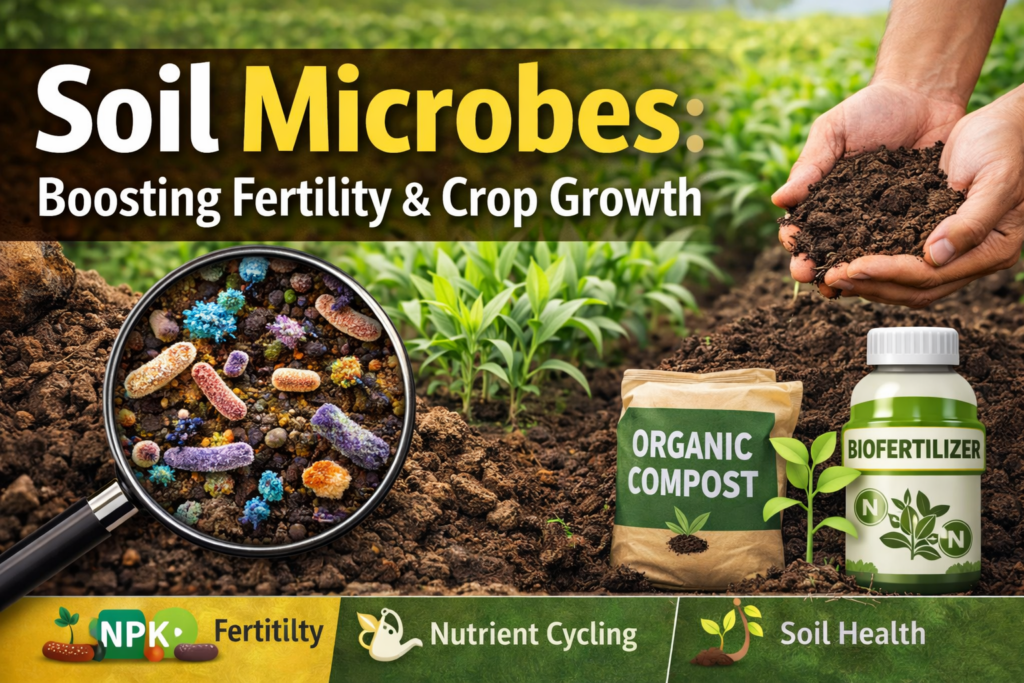
Soil Microbes: The Hidden Workforce Powering Crop Growth & Soil Fertility
Beneath every healthy farm lies an invisible workforce working tirelessly to support plant growth and food production. Soil microbes — tiny organisms such as bacteria and fungi — drive nutrient cycling, improve soil structure, and strengthen crop resilience.
When these microscopic organisms eat and thrive, they unlock nutrients for crops. That is why we can truly say:
👉 Microbes eat, therefore we eat.
Soil: A Living Ecosystem, Not Just Dirt
-,
Soil is a living ecosystem filled with billions of microorganisms. These include:
-
bacteria
-
fungi
-
actinomycetes
-
protozoa
-
beneficial nematodes
Together, they perform nearly 90% of biological and chemical processes in soil.
By feeding on organic matter, root exudates, and other microbes, they convert raw materials into nutrients plants can absorb.
Microbes: Nature’s Nutrient Managers
One of the most vital roles of soil microbes is nutrient transformation.
Essential nutrients like nitrogen, phosphorus, and potassium may exist in soil but remain unavailable to plants until microbes convert them into soluble forms.
Key Microbial Functions
✔ Nitrogen Fixation
Bacteria such as Azotobacter convert atmospheric nitrogen into plant-usable forms.
✔ Organic Matter Decomposition
Decomposer microbes break down crop residues and manure.
✔ Humus Formation
This process creates humus — a stable organic matter that improves fertility.
Why Humus Matters
-
improves soil structure
-
increases water-holding capacity
-
reduces erosion
-
enhances nutrient retention
Microbes ensure nutrients are continuously recycled instead of lost.
Guardians of Soil Health

Soil microorganisms influence soil health in many ways:
✔ Improve Soil Structure
Their movement and secretions help bind soil particles, improving aeration and water infiltration.
✔ Balance Soil Chemistry
Microbial activity can gradually buffer extreme soil pH levels.
✔ Promote Root Growth
Microbes release:
-
plant hormones
-
vitamins
-
carbon dioxide
These stimulate root development and plant vigor.
✔ Protect Against Diseases
Beneficial microbes suppress pathogens by:
-
competing for nutrients and space
-
producing natural antibiotics
Some microbes even break down pesticide residues, improving soil cleanliness.
Microbes Help Crops Survive Stress
Modern agriculture faces challenges such as:
-
drought
-
heat stress
-
salinity
-
erratic rainfall
Beneficial microbes improve crop resilience by enhancing root growth and water uptake.
Healthy microbial activity can also improve taste, aroma, and nutritional quality in produce by supporting balanced plant nutrition.
Managing Soil Microbes for Better Farming
Farmers can encourage beneficial microbes through simple practices:
✔ Add Organic Matter
Apply compost, manure, or crop residues.
✔ Reduce Excessive Tillage
Minimize soil disturbance to protect microbial habitats.
✔ Practice Crop Rotation
Diverse crops support diverse microbial communities.
✔ Use Biofertilizers & Microbial Inoculants
Introduce beneficial microbes to boost soil biology.
✔ Avoid Overuse of Chemicals
Excess fertilizers and pesticides can harm soil life.
Over time, biologically active soils reduce dependence on costly inputs.
Soil Biology & Future Food Security
As climate change intensifies and the global population grows, improving soil biology is essential for sustainable agriculture.
Healthy microbial life supports:
✅ long-term soil fertility
✅ climate resilience
✅ improved crop yield
✅ better food quality
Understanding that human nutrition begins with soil nutrition shifts agriculture toward life-centered soil management.
When farmers care for microbes, they strengthen the entire food chain.
Because when microbes eat, we eat.